
Before you commit to onyx countertops, ask yourself a few honest questions. Where will this natural stone countertop live, a kitchen, a bathroom, or an onyx bar? Are you choosing it for durability, or for translucency and natural beauty?
Are you okay with careful maintenance if it means a one-of-a-kind look? This guide covers the pros and cons of onyx so you can make the right choice with clear expectations.
The advantages of onyx countertops: why people fall in love with them
Onyx is not chosen because it is easy. It is chosen because it creates a reaction. The advantages of onyx countertops are tied to how they look, how they feel, and the kind of presence they bring into a space. If you are drawn to onyx, it is usually for reasons that have very little to do with practicality.
Translucency and light: the feature that defines onyx
Onyx is a natural stone known for its translucency. Unlike most stone countertops, light can pass through an onyx slab, creating depth, glow, and movement within the stone itself.
When backlight is introduced, the surface stops feeling flat and starts behaving more like an illuminated design feature.
This is why backlit onyx is most often used in:
- Onyx bars and bar countertops
- Feature walls and vertical surfaces
- Accent areas where visual impact matters more than durability
This effect cannot be replicated by granite, quartz, or marble. Other stones reflect light. Onyx interacts with it.
Veining, color, and one-of-a-kind visual impact
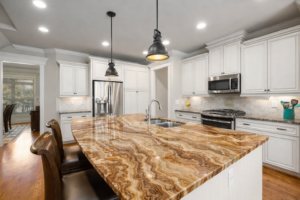
Onyx is chosen to be noticed. It comes in a stunning array of colors, each with its own personality. White onyx feels soft and luminous. Green onyx is dramatic and organic. Black onyx creates depth and intensity. Beyond color, the veining is what gives onyx its character.
What sets onyx apart visually:
- Bold, flowing veining that feels almost sculptural
- Natural movement that makes the surface feel alive
- Unique patterns that cannot be duplicated from slab to slab
No two onyx slabs look the same. That exclusivity is part of the appeal. When someone chooses onyx, they are not looking for uniformity. They are looking for a surface that feels intentional and rare.
The emotional appeal: elegance, luxury, and statement value
Some countertop choices are about function. Onyx is about experience.
Onyx brings a level of elegance and sophistication that immediately changes how a space feels. It is often used as a focal point, something that draws attention and invites conversation. In the right setting, it adds a touch of luxury that feels curated rather than practical.
This is why onyx appeals to people who:
- Value natural beauty over convenience
- Want a statement piece rather than a background surface
- Are comfortable choosing impact instead of efficiency
Onyx is not trying to blend in. Its advantage is that it does the opposite.
The cons of onyx countertops: what you need to understand upfront
The drawbacks of onyx are not design failures. They are part of what makes the stone what it is.
Porosity and staining: why guidance matters
Onyx is a porous stone, which means it reacts to liquids differently than denser materials. This does not automatically make it a poor choice, but it does mean spills cannot be ignored.
Things like oils, wine, and deeply pigmented liquids can soak in if they sit too long. With proper care and sealing, staining can often be avoided. The key is knowing where onyx fits best and how it should be treated from day one.
When placed thoughtfully and maintained correctly, this characteristic becomes manageable rather than problematic.
Etching and acidic substances: understanding how onyx reacts
Acidic substances can etch the surface, dulling the polish and subtly changing the texture. This surprises people who expect all stone countertops to behave the same way. The reality is that some surfaces are meant to be handled gently.
This does not mean onyx is unsuitable. It means it should be used in areas where contact with acidic foods and cleaners is limited, and where its visual impact can be enjoyed without constant risk. Knowing this ahead of time allows for smarter placement and fewer regrets.
Maintenance, sealing, and long-term ownership
The onyx countertop material is not a low-maintenance stone, and it should never be sold as one.
Regular sealing is part of proper care, and mindful daily habits help preserve the surface. Onyx countertops require attention, but they also reward it.
When owners understand what the stone needs and have access to honest guidance, onyx becomes a long-term design feature rather than a source of stress.
This is why working with experts who are willing to explain both the beauty and the responsibility matters. The stone performs best when the expectations are clear, and the support is there.
Thinking about using onyx?
Onyx can be a beautiful choice when it is placed thoughtfully and handled with care. The difference usually comes down to working with the right experts.
A fabricator who understands onyx will help you decide where it makes sense, where it does not, and what it truly requires, rather than just pushing a sale.
If you want clarity before committing:
- Talk through placement with a fabricator experienced with onyx
- Review slab selection and lighting options
- Get a free countertop consultation and honest guidance before moving forward
Making the right decision starts with the right conversation.
FAQs
Do onyx countertops stain or etch easily
Onyx can stain or etch if spills are left too long or if acidic substances come into contact with the surface. Since onyx is a natural material, it reacts more than granite or quartz. Proper sealing and mindful cleaning reduce risk, but this stone is not designed to be treated as easy to clean or maintenance-free. Understanding this upfront prevents disappointment later.
Are onyx countertops practical for kitchens
In most cases, no. Kitchen countertops face heat, spills, and frequent cleaning, which makes onyx a challenging choice. Although granite and quartz are the most popular options for kitchens, onyx behaves very differently.
Compared to granite or quartz, onyx is more susceptible to damage from daily use. It is better reserved for areas where visual impact matters more than durability.
Where does onyx work best in a home
Onyx works best in low-contact, statement spaces. Onyx bar countertops, home bars, backsplashes, and accent surfaces allow light to pass through the stone and highlight its translucence. These placements protect the stone while showcasing what makes it special. When used this way, onyx adds beauty to a space without constant risk.
How much maintenance do onyx countertops require
Onyx countertops require regular sealing and careful day-to-day habits. This includes wiping spills quickly, avoiding acidic cleaners, and working with experienced fabrication and installation professionals.
Onyx is not high-maintenance in the sense of constant work, but it does require attention. This level of care should match your expectations before installing onyx countertops.
Is an onyx stone worth the effort
An onyx countertop can be a worthwhile investment when chosen intentionally and placed correctly. It is not a universal choice for homeowners, but for those who value natural beauty, translucence, and one-of-a-kind stone slabs, the effort can be worth it.
The key is selecting onyx with guidance from experts who understand both its advantages and its limits, rather than treating it like granite countertops or other popular stone options.