
Most homeowners hear the same thing when comparing porcelain vs. quartz countertops: they’re both durable. That’s true, but it’s also incomplete. Durability isn’t a single trait; it’s how a countertop material handles heat, impact, scratches, stains, and daily use over years, not weeks.
After fabricating and installing thousands of quartz and porcelain countertops, we’ve seen where each one excels, and where assumptions can fall apart in a real kitchen or bathroom.
What “Durable” Really Means for a Countertop
When people talk about a durable countertop, they’re often thinking about strength alone. In reality, durability is a combination of the different ways a countertop material handles daily use over time, especially in kitchens and bathrooms, where surfaces are constantly tested.
What actually matters comes down to a few core factors:
- Resistance to scratches and chips from cookware, utensils, and everyday impact
- Heat tolerance, especially near cooktops and hot pans
- Stain resistance and porosity, which affect how easily a surface absorbs spills
- Thickness and structural support, which influence long-term stability
- Performance under daily use, not just how the material looks when it’s new
A countertop can be highly durable on paper and still struggle in the wrong environment. That’s why durability should be evaluated based on how the space is used, not on marketing claims or material labels alone.
Quartz Countertops: Engineered Strength and Consistency
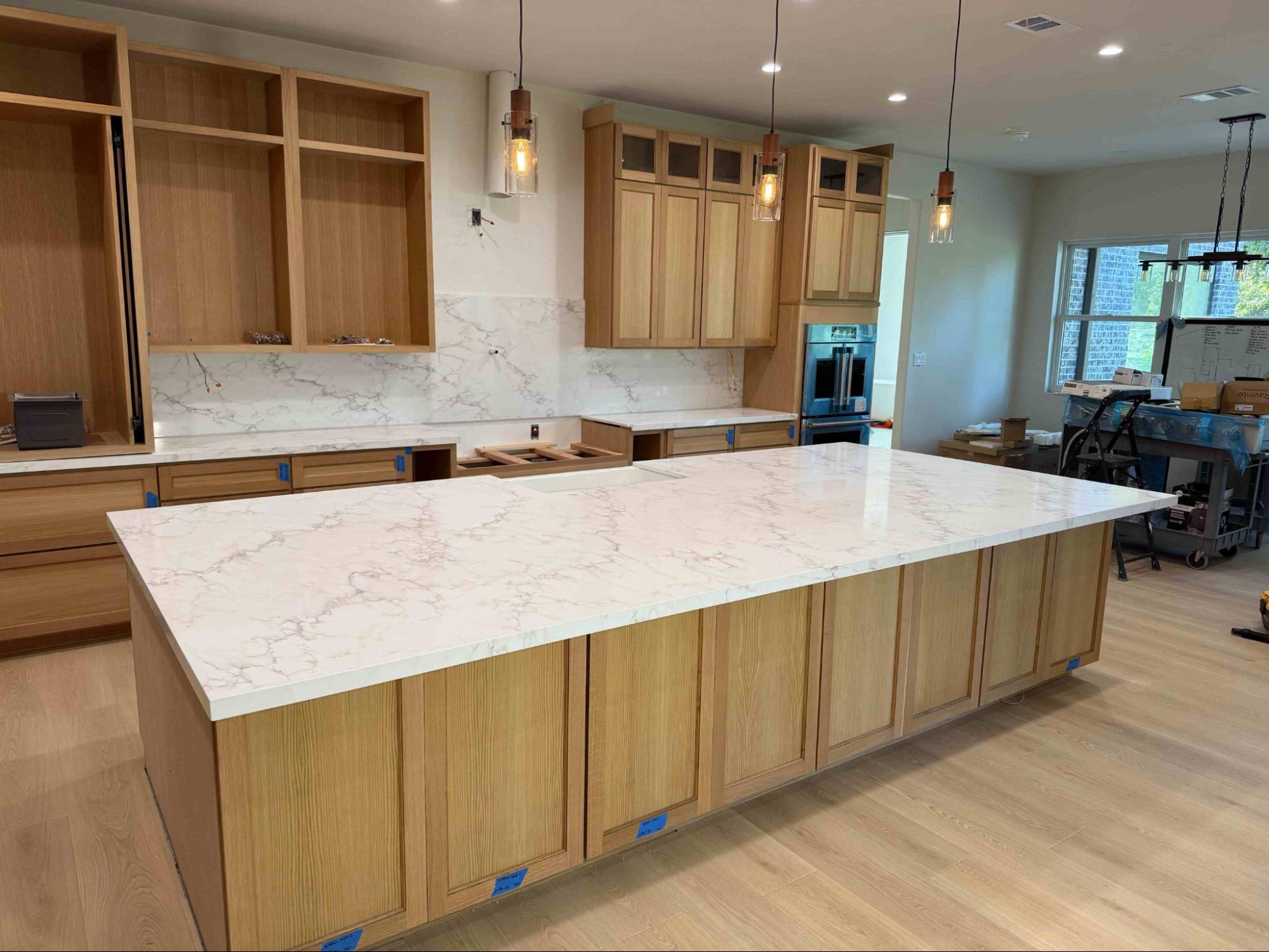
What Quartz Countertops Are Made Of
Quartz countertops are an engineered stone, made by combining natural quartz crystals with resins and pigments. The result is a dense, uniform quartz surface designed for consistency and reliability.
Unlike natural stone such as granite or marble, quartz is manufactured rather than quarried as a solid slab. That engineered process allows for controlled color, pattern, and performance.
For design-driven homeowners, this consistency matters. It makes it easier to match slabs, plan seams, and achieve a clean, intentional look across a kitchen or bathroom.
Durability of Quartz in Daily Use
When it comes to everyday performance, the durability of quartz is one of its biggest strengths. Quartz countertops are highly resistant to scratches and stains, which makes them well-suited for busy kitchens and bathrooms.
Because quartz is non-porous, it doesn’t absorb liquids the way some natural stone surfaces can. That means it doesn’t require sealing and is less likely to stain from common household spills.
That said, quartz isn’t indestructible. While it handles daily wear well, excessive heat or heavy impact can still cause damage. Using trivets near cooktops and avoiding direct contact with extremely hot cookware helps protect the surface over time.
Practical Considerations with Quartz
Quartz slabs are typically thicker and heavier than porcelain, which affects both fabrication and installation. That added thickness allows for a wider range of edge profiles and design flexibility, especially in kitchens where the countertop becomes a focal point.
Long-term, many homeowners see value in the durability, low maintenance, and consistent appearance of quartz countertops.
Maintenance is straightforward. Routine cleaning with mild soap and water is usually all that’s needed to keep a quartz countertop looking its best; no sealing, no special treatments, just regular care.
Porcelain Countertops: Thin, Dense, and Exceptionally Hard
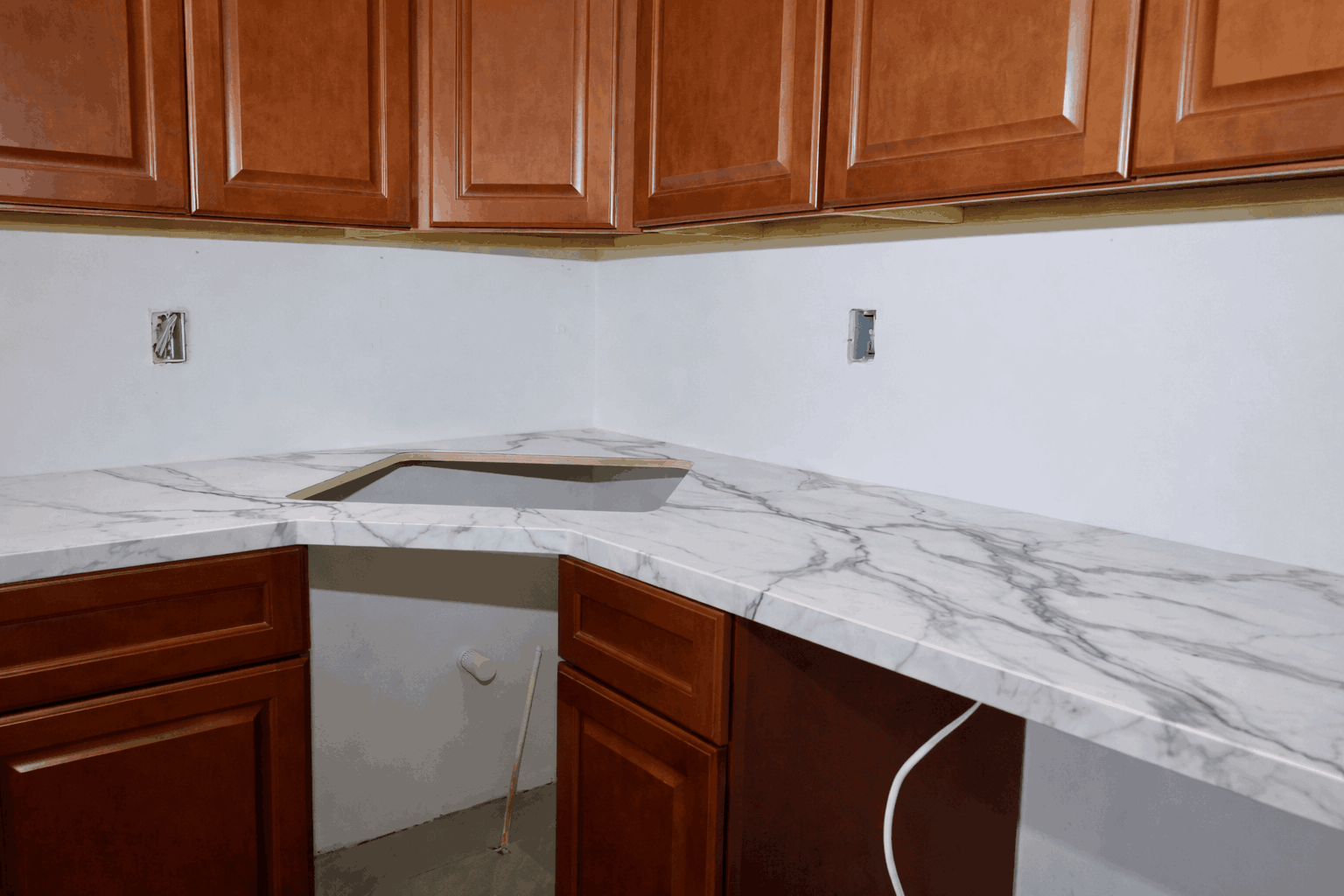
What Are Porcelain Countertops?
Porcelain countertops are made from refined clays and natural minerals that are pressed and fired at extremely high temperatures. That firing process creates a dense, durable porcelain slab with very low absorption.
Unlike quartz, porcelain is not bound with resin. It’s also different from natural stone, which is quarried in solid blocks. Because of how porcelain is manufactured, slabs can be produced thinner and lighter than quartz, while still maintaining impressive strength. This thinner profile opens up design possibilities and use cases that aren’t always practical with thicker materials.
The Durability of Porcelain Surfaces
From a durability standpoint, porcelain surfaces perform exceptionally well in demanding environments. They are highly resistant to heat, UV exposure, and scratches, which makes them a strong option for kitchens, bathrooms, and even outdoor applications.
Porcelain is also resistant to staining due to its very low porosity. Spills are less likely to penetrate the surface, and routine cleaning is typically straightforward.
Where porcelain often outperforms quartz is in heat tolerance and sun exposure. However, its thinner profile means impact resistance depends more on proper support and installation. The material itself is hard, but you need to plan better for its use.
Installation and Use Considerations
With porcelain countertops, installation quality plays an outsized role in long-term performance. Because slabs are thinner, proper support and precise fabrication are critical to prevent cracking or flexing over time.
For indoor installations, porcelain countertops are typically installed over standard cabinet support, similar to other countertop materials.
For outdoor applications, however, proper substrate preparation becomes more important. Exterior installations require a stable, weather-resistant base to account for moisture, temperature shifts, and environmental exposure.
Edge options are more limited compared to thicker quartz countertops, and designs often favor clean, modern profiles rather than heavy edges.
Porcelain offers flexibility across many applications, including kitchen countertops, bathroom surfaces, vertical panels, and outdoor spaces. When the material is matched with the right use case and installed correctly, it delivers durability and performance that hold up well over time.
Quartz vs. Porcelain: Durability Compared Side by Side
When comparing quartz vs. porcelain countertops, both materials are durable, but in different ways. Understanding how each one responds to real-world use helps you choose what works and not just what looks appealing.
Scratch Resistance
- Quartz countertops are highly resistant to scratches from daily kitchen use, thanks to their dense, engineered composition.
- Porcelain countertops are extremely hard and also resistant to scratches, especially from utensils and cookware.
Both perform well here, though neither should be treated as completely scratch-proof.
Heat Resistance
This is where the difference in porcelain vs. quartz becomes more noticeable.
- Porcelain handles high heat and temperature changes better, including hot cookware and sun exposure.
- Quartz can be damaged by excessive heat due to the resins used in engineered stone, making heat protection important near cooktops.
Impact and Chipping Risk
- Quartz is thicker and has more mass, which can help absorb minor impacts.
- Porcelain is very hard but thinner, so edge impact and unsupported areas require more planning.
In practical terms, both materials perform well when properly installed, but porcelain demands slightly more precision. Neither is inherently “stronger” overall; the strength shows up differently depending on the application.
Maintenance and Long-Term Wear
- Both porcelain and quartz countertops are non-porous and resistant to staining.
- Neither material requires sealing.
- Long-term wear depends more on how the surface is used than on the material itself.
Routine cleaning and basic care go a long way with either option.
Real-World Kitchen Use
- Quartz performs exceptionally well in busy, high-traffic kitchens where consistency and impact resistance matter.
- Porcelain excels in environments with heat exposure, sunlight, or modern design demands.
The right choice depends less on which material is “better” and more on how the kitchen functions day to day.
Get Expert Guidance Before You Decide
Durability isn’t just about material; it’s about fabrication, installation, and how the countertop will be used every day. The perfect countertop for your kitchen or bathroom comes from matching the right surface to your lifestyle, space, and long-term goals.
At KAT Fabricators, we help homeowners and builders sort through the real differences between materials and choose with confidence, not guesswork.
Next steps:
- Schedule a Free Estimate
- Talk With a Countertop Specialist
- Explore Quartz and Porcelain Options With Our Team
FAQs: Common Questions About Quartz and Porcelain Countertops
Is porcelain more durable than quartz?
Porcelain and quartz are both durable, but in different ways. Porcelain is extremely hard and can better withstand heat and UV exposure. Quartz offers strength through thickness and impact resistance. When choosing between quartz and porcelain, durability depends on how the countertop will be used, not just the material itself.
Do quartz countertops scratch easily?
No. Quartz countertops are highly resistant to scratches from everyday use. Like any countertop surface, sharp or heavy impact can still cause damage, but under normal kitchen conditions, quartz holds up well.
Can porcelain countertops chip?
They can, especially along edges. Because porcelain is thinner than quartz, proper support and careful installation matter. The material itself is hard, but edge protection and substrate planning play a big role in long-term performance.
Do quartz or porcelain countertops require sealing?
No. Both quartz countertops and porcelain countertops are non-porous. Unlike natural stone countertops such as granite and marble, they don’t require sealing and are easier to maintain over time.
Which material lasts longer in a kitchen?
Both materials are built to last. Quartz often performs well in high-traffic family kitchens, while porcelain excels in spaces exposed to heat or sunlight. The material that lasts longest is the one that best matches the way the kitchen is actually used.
Is porcelain or quartz better for bathrooms?
Both work well for kitchen and bathroom countertops. Porcelain is often chosen for bathrooms because of its thin profile and moisture resistance. Quartz is popular for its consistency in color and pattern and its ability to coordinate across multiple surfaces.
How does quartz compare to granite and marble for durability?
Quartz is an engineered stone, while granite and marble are natural stone countertops. Quartz is generally more resistant to stains and doesn’t require sealing. Granite is durable but porous, and marble is softer and more prone to etching. Each material offers different strengths depending on use and expectations.